Our neighbors, John and Sue Bibeau, recently sold their home (2666 Lake Shore) and moved to Brainerd. John and Sue have been some of the best neighbors and friends we've had in our lives. Not only will they be missed because of their kind and generous natures, but their contribution to the neighborhood has been immense.
John has lived in Little Canada and on Lake Shore for most of his life. He has seen the neighborhood in good times and bad. John and Sue were always involved in community events and a great source of insight into the city's history.
For the two years that Little Canada paid for our lake's lily spraying permits, John volunteered his time and energy to man the pumps for two days each year. Because of that, our lake has had a chance to make a come-back and it has been possible to enjoy boating on that precious resource and the view from our back yards was dramatically improved with a little water visible on the lake. "Fixing" the lake is a long way in the future, but that wasn't a bad start.
John was always quick to lend a hand at any project that might improve the neighborhood. We particularly appreciated his willingness to help with the "project" that our home turned out to be. Without their patience and assistance, I suspect we might not have managed to turn our place around and make it livable. We will miss John and Sue a lot and will try to welcome our new neighbors as generously as John and Sue did for us.
This blogsite is intended for lakeshore owners in Little Canada, Minnesota who have property on the shores of the much-abused Savage Lake. Your help is needed to protect this historic small lake.
Showing posts with label water lillies. Show all posts
Nov 19, 2012
Aug 19, 2011
Last Spraying
We received our permit to spray the lake for water lilies one last time (on the city's buck) early this week. We need at least two dry days for Rodeo to do it's work and the weather report for the weekend seemed sort of undependable up until this morning, so I didn't get the paperwork into the DNR in time. I hope to try again next week. This has been an over-full week for me as it is.
I hate to toss in the towel, but I think this labor of frustration and solitude is about to end. I named this website/blog the "Savage Lake, Little Canada, Minnesota Lake Owners' Association" with the hopelessly optimistic goal that there might actually be such a group in the near future.HTML clipboard The website has been around since May of 2008 and we're no closer to being that organization than we were when I wrote the first entry, "Getting Started." Someone said, "You get the government you deserve." With that in mind, I think we are getting the mosquito infested swamp we deserve as we passively let this small body of water deteriorate into mess it has become. I loved our little lake a few years ago. Today, it has become a liability.
It is nothing but painful to me to look out of my backyard and see the lake we once enjoyed become the disaster the Watershed District so desperately and incompetently wanted it to be. Not that many years ago, we canoed this lake almost every summer evening. On muggy days, we'd paddle to the interior of the lake to avoid bugs in the backyard. Now, the lilies have made fine nesting homes for every kind of biting insect that lives in Minnesota and the lake is the last place you want to be when the damn things are out hunting. One of our neighbors has been trying to sell his home for a while and at least one prospective buyer stated that they lost interested in the home because of the freeway noise. A more interested buyer would probably have second thoughts after experiencing the insect "wildlife" some evening. Our backyard is worse than our front yard and simply crossing the street is enough to reduce the need for bug repellent considerably.
John Bibeau has, again, volunteered to help spray the lake this last time. I'll use this website to post when that will be as soon as we set a date with the DNR. After that, I'm going to shut the site down. I'm too old to bang my head against a closed door.
I hate to toss in the towel, but I think this labor of frustration and solitude is about to end. I named this website/blog the "Savage Lake, Little Canada, Minnesota Lake Owners' Association" with the hopelessly optimistic goal that there might actually be such a group in the near future.
It is nothing but painful to me to look out of my backyard and see the lake we once enjoyed become the disaster the Watershed District so desperately and incompetently wanted it to be. Not that many years ago, we canoed this lake almost every summer evening. On muggy days, we'd paddle to the interior of the lake to avoid bugs in the backyard. Now, the lilies have made fine nesting homes for every kind of biting insect that lives in Minnesota and the lake is the last place you want to be when the damn things are out hunting. One of our neighbors has been trying to sell his home for a while and at least one prospective buyer stated that they lost interested in the home because of the freeway noise. A more interested buyer would probably have second thoughts after experiencing the insect "wildlife" some evening. Our backyard is worse than our front yard and simply crossing the street is enough to reduce the need for bug repellent considerably.
John Bibeau has, again, volunteered to help spray the lake this last time. I'll use this website to post when that will be as soon as we set a date with the DNR. After that, I'm going to shut the site down. I'm too old to bang my head against a closed door.
Jun 23, 2011
Cattails and Minnesota Revisited
Hopefully, you've all recieved notice from the city that Little Canada will, again, be paying for our DNR property permits for spraying the lillies. Please get the forms back ASAP so we can get on with the spraying before the plants start to flower and seed. The earlier the better. And don't forget to thank Joel Hanson (joel.hanson@ci.little-canada.mn.us) and the city council members for getting this started without our having to rattle their cages. The work we did last fall definately had an effect on the lillie growth this year and the high water is helping, too. We might just get our lake back if we keep after it.
Jun 21, 2011
Where We Are Today
I stopped by the city offices last week to look at the plans for the upgrades to I35E between Highway 36 and the I35E and I694 rats' nest, but the city doesn't have anything to show, yet. Supposedly, we're going to be getting some noise abatement design into the work, but based on the amateur work I saw from the state with the "analysis" of the impact on our homes with the last work on that roadway, I don't expect much value from that. Honestly, if one of my Musical Acoustics students turned in a final project that was as poorly written and analyzed, I'd fail him.
[Note: The clear weather pictures above are from early June and the overcast pictures were taken 6/21/2011.]
The lake water height has been at historic levels almost all spring, thanks to an extremely wet spring. That hasn't, however, had much impact on the lily growth. It is gratifying to see that last fall's Rodeo spraying has given us some clear water this spring, which indicates that we could get control of this pest weed if the DNR weren't an obstacle and the Water Shed District made some sort of useful contribution. Unlike this time last year, we've been able to canoe the lake in the evening and, other than the dramatic increase in mosquitoes, it's nice to have some of our lake back.
The milfoil is another issue. I found some minnows tangled in that crap near our dock, which is a great demonstration of how destructive that weed is. You'd think the DNR and Watershed District would want to aggressively control this crap at the headwaters of our county's major lakes, since lakes like ours feeds all of the big lakes and there will be no way to get rid of the weed without getting rid of it upstream.
There was some noise about how the city was going to make one last contribution to lake shore owner DNR weed eradication permits, but I haven't heard anything new on that subject either. Regarding the milfoil, it almost seems like we're going to have to get out on our shorelines with a rake and drag the junk out of the lake manually.
Speaking of the Watershed District, they use our lake access to make some sort of water sample, drainage analysis a few times every year. I don't know what results from that testing, but you'd think it would be the kind of thing they'd make available to lake shore owners and the city. Anyone have an idea where that information might exist?
Our pair loons left town a couple of weeks ago. I'd become used to hearing them trumpet every morning and when it stopped it seemed like a good neighbor had moved away. I guess we should just feel lucky to have had them for as long as we did.
[Note: The clear weather pictures above are from early June and the overcast pictures were taken 6/21/2011.]
The lake water height has been at historic levels almost all spring, thanks to an extremely wet spring. That hasn't, however, had much impact on the lily growth. It is gratifying to see that last fall's Rodeo spraying has given us some clear water this spring, which indicates that we could get control of this pest weed if the DNR weren't an obstacle and the Water Shed District made some sort of useful contribution. Unlike this time last year, we've been able to canoe the lake in the evening and, other than the dramatic increase in mosquitoes, it's nice to have some of our lake back.
The milfoil is another issue. I found some minnows tangled in that crap near our dock, which is a great demonstration of how destructive that weed is. You'd think the DNR and Watershed District would want to aggressively control this crap at the headwaters of our county's major lakes, since lakes like ours feeds all of the big lakes and there will be no way to get rid of the weed without getting rid of it upstream.
There was some noise about how the city was going to make one last contribution to lake shore owner DNR weed eradication permits, but I haven't heard anything new on that subject either. Regarding the milfoil, it almost seems like we're going to have to get out on our shorelines with a rake and drag the junk out of the lake manually.
Speaking of the Watershed District, they use our lake access to make some sort of water sample, drainage analysis a few times every year. I don't know what results from that testing, but you'd think it would be the kind of thing they'd make available to lake shore owners and the city. Anyone have an idea where that information might exist?
Our pair loons left town a couple of weeks ago. I'd become used to hearing them trumpet every morning and when it stopped it seemed like a good neighbor had moved away. I guess we should just feel lucky to have had them for as long as we did.
Apr 25, 2011
Spring or Not
I think it's spring on Savage Lake. I don't know for sure because there is a chance we'll get snow tomorrow night. However, last Friday I was working in my yard and heard a sound I haven't heard in years; loons calling. Sure enough, there were a pair of Great Northern Divers, or common loons, on our lake and they were very vocal.
We took the canoe out today and tried to get a few shots of the loons without scaring them off. As a photographer, I suck. But the birds tried to accommodate us and, at least, I came away with evidence if not with memorable nature shots.
Yesterday, we made the same trip and I only wish I had thought of a camera then. We saw the two loons, egrets, herons, geese, wood ducks, mallards, red-wing blackbirds, cardinals, snapping turtles, muskrats, deer, and hawks. One of the loons put on a show of feathers that made me decide to try the lake again, today, in case it happened again. No such luck, but they did seem pretty unconcerned by our presence and kept at their diving and swimming while we paddled around the lake.
With all the freeway noise, it's hard to hear the bird song from our lake, but it's out there and would be a shame to lose it. The lilies are about to make their damned appearance and the milfoil is already making a run for dominance. Hopefully we can get a head start on beating back the lilies this year and our lake will stay recreational all year.
We took the canoe out today and tried to get a few shots of the loons without scaring them off. As a photographer, I suck. But the birds tried to accommodate us and, at least, I came away with evidence if not with memorable nature shots.
Yesterday, we made the same trip and I only wish I had thought of a camera then. We saw the two loons, egrets, herons, geese, wood ducks, mallards, red-wing blackbirds, cardinals, snapping turtles, muskrats, deer, and hawks. One of the loons put on a show of feathers that made me decide to try the lake again, today, in case it happened again. No such luck, but they did seem pretty unconcerned by our presence and kept at their diving and swimming while we paddled around the lake.
With all the freeway noise, it's hard to hear the bird song from our lake, but it's out there and would be a shame to lose it. The lilies are about to make their damned appearance and the milfoil is already making a run for dominance. Hopefully we can get a head start on beating back the lilies this year and our lake will stay recreational all year.
Oct 11, 2010
Our Neighborhood
The lake is as nice as it has been all year. While we're all waiting for the hammer of winter to drop, it's prime time to visit the lake and see the fall colors, the remaining wildlife, and enjoy the relatively clear water while it lasts. As we lapped the lake tonight, we were struck by how beautiful our neighborhood is. We're lucky to have so many neighbors who treasure their homes and yard. Our hidden neighborhood is one of the Cities' unknown treasures.
We made a lap around the lake, from north to south and took some shots of the lakeshore from almost every angle. See if you can spot your house from here.
The mild and long Indian Summer has allowed the lilies to last longer than usual and the milfoil is doing pretty well, too. The freeway drain at the north east end of the lake is totally filled by sediment. That end of the lake is also a little more shallow than it was a year ago and a lot more shallow than it was 5 years ago. There was a statement made in a City Council meeting a few years ago claiming that the DOT had stopped draining the freeway entrance runoff into the lake. That is only true because the runoff completely clogged the drain. That's not what I'd call an "engineered solution." That's just more of the sloppy engineering that turned our lake into a catch basin for the freeway expansion and allowed unhealthy and illegal levels of noise to be reflected from the east side freeway barriers at our homes.
So as we enjoy the hard work of our neighbors and the beauty of a Minnesota fall, we should be figuring out how to fix the problems on our lake during the winter months so that we can enjoy the lake all year next season.
We made a lap around the lake, from north to south and took some shots of the lakeshore from almost every angle. See if you can spot your house from here.
The mild and long Indian Summer has allowed the lilies to last longer than usual and the milfoil is doing pretty well, too. The freeway drain at the north east end of the lake is totally filled by sediment. That end of the lake is also a little more shallow than it was a year ago and a lot more shallow than it was 5 years ago. There was a statement made in a City Council meeting a few years ago claiming that the DOT had stopped draining the freeway entrance runoff into the lake. That is only true because the runoff completely clogged the drain. That's not what I'd call an "engineered solution." That's just more of the sloppy engineering that turned our lake into a catch basin for the freeway expansion and allowed unhealthy and illegal levels of noise to be reflected from the east side freeway barriers at our homes.
So as we enjoy the hard work of our neighbors and the beauty of a Minnesota fall, we should be figuring out how to fix the problems on our lake during the winter months so that we can enjoy the lake all year next season.
Sep 18, 2010
Bits of the Mission Accomplished
When I got back from Texas, a week after John and I sprayed, looking at the lake was pretty discouraging. Earlier this week, I was driving past our lake on I35E and I could have sworn I saw the outline of the route John and I took with the canoe and Roundup. Friday, we canoed out into the lake and discovered that canoeing is possible. Today, my wife and I ventured out on the lake with a camera and took some pictures of our lake and, I hope, you can see where John and I whipped up on the lilies; and where we didn't.
The recommended 2nd round of spraying would have really cleaned out the open areas. But you can easily get around the lake and if it's far from perfect it's also far from completely jammed with lilies. The large treated center section is considerably less populated than the untreated edges. Some of the pictures show the difference pretty clearly. The path around the island is less obvious, but in the right light from the right angle, you can see where we were. On the canoe, the cleared area is the only path around the lake.
Some of my wife's pictures show how badly the lake is infected with milfoil. I have no idea how we're going to beat back this contamination, but I suspect that we need some more life in the lake to help with this; animals and fish. There was more life on the lake this afternoon than there was all summer. We spotted a dozen geese, the same number of ducks, a couple herons, and a couple of least bitterns. If we can get an early start with the herbicide next spring, maybe some of the birds and animals will stick around for the summer. The lily infestation pretty much forces the birds to look elsewhere for habitat and hunting.
The recommended 2nd round of spraying would have really cleaned out the open areas. But you can easily get around the lake and if it's far from perfect it's also far from completely jammed with lilies. The large treated center section is considerably less populated than the untreated edges. Some of the pictures show the difference pretty clearly. The path around the island is less obvious, but in the right light from the right angle, you can see where we were. On the canoe, the cleared area is the only path around the lake.
Some of my wife's pictures show how badly the lake is infected with milfoil. I have no idea how we're going to beat back this contamination, but I suspect that we need some more life in the lake to help with this; animals and fish. There was more life on the lake this afternoon than there was all summer. We spotted a dozen geese, the same number of ducks, a couple herons, and a couple of least bitterns. If we can get an early start with the herbicide next spring, maybe some of the birds and animals will stick around for the summer. The lily infestation pretty much forces the birds to look elsewhere for habitat and hunting.
Sep 5, 2010
Fall and Herbicides
It looks like we managed to spray our herbicide on the lilies about the time they would have died naturally. Hopefully, that means next spring's crop will be slowed up a bit.
It struck me that the permit process is probably an annual deal, with a September 1 expiration. If that's so, we ought to have the city apply for next year's permit as soon as possible. Then, we'll have the whole growing season to attack those things and, maybe, keep the lake free all season.
Aug 30, 2010
Someone Is Fighting for Us
Apparently, the DNR "experts" are somewhat clueless about lake life cycles and the effect of uncontrolled plant life in a small lake. This comment, in particular, seemed about as ignorant as anything I've heard in the last 9 years from DNR bureaucrats, "water lilies, a native plant that provides wildlife habitat and water quality benefits. Healthy populations of native aquatic plants are integral to the ecological health of our lakes, but they can also hinder recreation, particularly if they are abundant on the lake's surface. The DNR's APM program tries to balance the protection of aquatic plants with the need for lake shore residents to gain recreational access to the water. " The plant is certainly "native" to our part of North America but anyone capable of walking to the lake shore would see that the infestation of plants in our lake is as far from a "healthy population" as is possible.
I'd love to know how the DNR's bureaucratic inactivity could be described as any sort of "program." As far as I can see, the DNR's sole purpose is to burn its budget without any useful benefit to taxpayers. Clearly, Mr. Hirsch has never set foot any where near Savage Lake, east or west or he is severely impaired in many ways.
Here is the text of a communication between our state representative, Bev Scalze, and the DNR commissioner's office. I was particularly heartened by her impassioned, direct approach to getting the DNR off of it's collective butt:
From: Bev Scalze [mailto: Rep.Bev.Scalze@house.mn]
Sent: Sunday, August 29, 2010 12:22 PM
To: Steve.Hirsch@state.mn.us
Cc: joel.hanson@ci.little-canada.mn.us; rep.jean.wagenius@state.mn; Bob.Meier@state.mn.us; Kathy.Anderson@state.mn.us; Mark.Holsten@state.mn.us; Sean.Sisler@state.mn.us
Subject: Re: Savage Lake aquatic plant control issues
Steve,
Thanks for sending the e-mail message.
However, the information that you relayed was information that had already been communicated by the City Administrator of Little Canada, Joel Hanson, and by Sean Sisler.
I would be glad to give you a tour of the area in question, or you may be able to view it on DNR maps prior to 1959 in comparison with the present day maps.
There is a freeway (35E) that bisected the 30-acre Savage Lake in 1959. It now has expanded to 10 lanes of asphalt with on/off ramps at Little Canada Road. The freeway has polluted the lake, and has also contributed to the decreased depth of Savage Lake with runoff. Now the DNR calls the water bodies west Savage Lake and east Savage Lake, which are considerably smaller because of the freeway. The lakeshore property owners, some of whom have lived there for 73 years, have suffered immense damages because of actions of the State of Minnesota and the Federal Government. The DNR Division of Waters should be more interested in the expansion of 35E which occurred in 2009-10 than they are with this current eradication permit request. Was there a DNR permit granted for the expansion? I would like to see a copy of that to compare with the current permit request from the City of Little Canada on behalf of the property owners.
The problem at Savage Lake regarding the denial by Mr. Sisler of the water lily eradication permit applications, is that there could be "anticipated" use that may not be visible to Mr. Sisler from some points of the lakeshore. A lakeshore property owner could have a canoe in a garage, or could possibly have friends or family that would like to bring over a canoe to the lakeshore property and use it for recreational purposes. A lakeshore property owner should not be required to petition Mr. Sisler with photographs and abstracts of their property. That is a very "heavy handed" DNR approach to the situation. The property owners have rights, and Mr. Sisler, or anyone else in his capacity, should not interfere with those rights to limited recreational use of their property. The property owners haven't been asking for clearing out all of the invasive lilies, nor are they asking to eradicate vegetation that helps the health of Savage Lake. To insinuate that they want to interfere with "healthy populations of native aquatic plants integral to the ecological health of the lake" doesn't give much credit to the property owners. They love their lake. They are not asking for long docks to reach open water as some in the state have done recently. They are simply asking for the ability to use their property in a limited recreational manner. Simply put, they are requesting the ability for anticipated access to open water for a canoe, boat or some other legal means. If they could achieve a channel to reach open water, perhaps they could then construct a dock for easier "visible" access. With the current heavy mat of lilies, it doesn't make much sense.
Since 2000, the overgrowth of water lilies has expanded greatly in Savage Lake. They were simply not there before that time in the massive quantities that are they are now. To apply DNR rules for "wildlife habitat and water quality" in a heavy-handed manner in a lake with 10-lanes of asphalt already going through it is simply ridiculous. The DNR's APM program should take into consideration the impact of the freeway on the property owner's recreational use of the lake, and allow these few residents some small amount of consideration and peace as they put up with the noise and pollution created by the State of Minnesota. To simply deny a permit for a channel through the expanding aquatic plants based upon "visible" recreational use is arbitrary at best. The most visible use of Savage Lake is the continuing harm of 10 lanes of asphalt, and that should not trump the rights of anticipated recreational use by lakeshore property owners.
If legislation would help in your consideration of these extreme situations, I would be glad to work with you on that level. Sometimes statewide "rules" are not fair to severely impacted metro property owners because of 10-lanes of asphalt in their lake, and exceptions are in order.
Please contact me with possible corrections to this situation.
Bev Scalze
State Representative, 54B
357 State Office Building
100 Rev Dr Martin Luther King Jr Blvd
St. Paul MN 55155
651/296-7153
651/296-4165 (fax)
rep.bev.scalze@house.mn
From: "Hirsch, Steve A (DNR)" 08/27/10 1:37 PM
Dear Representative Scalze:
Commissioner Holsten forwarded to me your August 24, 2010 email regarding aquatic plant management (APM) issues on Savage Lake. As you know, APM issues can be contentious and I am sorry this one has caused problems for your constituents. I hope you find the following information helpful.
The APM permit request for Savage Lake was to control water lilies, a native plant that provides wildlife habitat and water quality benefits. Healthy populations of native aquatic plants are integral to the ecological health of our lakes, but they can also hinder recreation, particularly if they are abundant on the lake's surface. The DNR's APM program tries to balance the protection of aquatic plants with the need for lake shore residents to gain recreational access to the water.
Savage Lake residents were permitted to control 3 acres of water lilies and to clear channels from their shoreline to the open water area. Apparently, some channels were denied because there was no evidence of recreational use along the shoreline. Our APM specialist who did the inspection was very liberal in determining evidence of recreational use; anyone with a dock, boat, canoe, kayak, or paddle boat was authorized a permit. One individual, who did not have a boat on the water, sent a picture of their boat with current registration and the permit was amended within a couple of days to allow a channel for that person. If there are other people in a similar situation, we would certainly be willing to amend the permit for them as well. These folks should contact Sean Sisler (651-259-5807; sean.sisler@state.mn.us) if they wish to amend the permit.
You also expressed concern with the amount of time it took for Savage Lake residents to receive their APM permit, indicating that there was more than a 30-day lag time. In checking with APM staff, however, I learned that DNR received the permit application on July 21 and mailed out the permit two weeks later on August 5. This seems like a reasonable turn-around time, especially since this was a new permit requiring a field inspection prior to issuance.
I hope that this has helped to address your concerns. Please let me know if you need additional information.
Sincerely,
Steve Hirsch, Director
Division of Ecological Resources
(651) 259-5106
I'd love to know how the DNR's bureaucratic inactivity could be described as any sort of "program." As far as I can see, the DNR's sole purpose is to burn its budget without any useful benefit to taxpayers. Clearly, Mr. Hirsch has never set foot any where near Savage Lake, east or west or he is severely impaired in many ways.
Here is the text of a communication between our state representative, Bev Scalze, and the DNR commissioner's office. I was particularly heartened by her impassioned, direct approach to getting the DNR off of it's collective butt:
From: Bev Scalze [mailto: Rep.Bev.Scalze@house.mn]
Sent: Sunday, August 29, 2010 12:22 PM
To: Steve.Hirsch@state.mn.us
Cc: joel.hanson@ci.little-canada.mn.us; rep.jean.wagenius@state.mn; Bob.Meier@state.mn.us; Kathy.Anderson@state.mn.us; Mark.Holsten@state.mn.us; Sean.Sisler@state.mn.us
Subject: Re: Savage Lake aquatic plant control issues
Steve,
Thanks for sending the e-mail message.
However, the information that you relayed was information that had already been communicated by the City Administrator of Little Canada, Joel Hanson, and by Sean Sisler.
I would be glad to give you a tour of the area in question, or you may be able to view it on DNR maps prior to 1959 in comparison with the present day maps.
There is a freeway (35E) that bisected the 30-acre Savage Lake in 1959. It now has expanded to 10 lanes of asphalt with on/off ramps at Little Canada Road. The freeway has polluted the lake, and has also contributed to the decreased depth of Savage Lake with runoff. Now the DNR calls the water bodies west Savage Lake and east Savage Lake, which are considerably smaller because of the freeway. The lakeshore property owners, some of whom have lived there for 73 years, have suffered immense damages because of actions of the State of Minnesota and the Federal Government. The DNR Division of Waters should be more interested in the expansion of 35E which occurred in 2009-10 than they are with this current eradication permit request. Was there a DNR permit granted for the expansion? I would like to see a copy of that to compare with the current permit request from the City of Little Canada on behalf of the property owners.
The problem at Savage Lake regarding the denial by Mr. Sisler of the water lily eradication permit applications, is that there could be "anticipated" use that may not be visible to Mr. Sisler from some points of the lakeshore. A lakeshore property owner could have a canoe in a garage, or could possibly have friends or family that would like to bring over a canoe to the lakeshore property and use it for recreational purposes. A lakeshore property owner should not be required to petition Mr. Sisler with photographs and abstracts of their property. That is a very "heavy handed" DNR approach to the situation. The property owners have rights, and Mr. Sisler, or anyone else in his capacity, should not interfere with those rights to limited recreational use of their property. The property owners haven't been asking for clearing out all of the invasive lilies, nor are they asking to eradicate vegetation that helps the health of Savage Lake. To insinuate that they want to interfere with "healthy populations of native aquatic plants integral to the ecological health of the lake" doesn't give much credit to the property owners. They love their lake. They are not asking for long docks to reach open water as some in the state have done recently. They are simply asking for the ability to use their property in a limited recreational manner. Simply put, they are requesting the ability for anticipated access to open water for a canoe, boat or some other legal means. If they could achieve a channel to reach open water, perhaps they could then construct a dock for easier "visible" access. With the current heavy mat of lilies, it doesn't make much sense.
Since 2000, the overgrowth of water lilies has expanded greatly in Savage Lake. They were simply not there before that time in the massive quantities that are they are now. To apply DNR rules for "wildlife habitat and water quality" in a heavy-handed manner in a lake with 10-lanes of asphalt already going through it is simply ridiculous. The DNR's APM program should take into consideration the impact of the freeway on the property owner's recreational use of the lake, and allow these few residents some small amount of consideration and peace as they put up with the noise and pollution created by the State of Minnesota. To simply deny a permit for a channel through the expanding aquatic plants based upon "visible" recreational use is arbitrary at best. The most visible use of Savage Lake is the continuing harm of 10 lanes of asphalt, and that should not trump the rights of anticipated recreational use by lakeshore property owners.
If legislation would help in your consideration of these extreme situations, I would be glad to work with you on that level. Sometimes statewide "rules" are not fair to severely impacted metro property owners because of 10-lanes of asphalt in their lake, and exceptions are in order.
Please contact me with possible corrections to this situation.
Bev Scalze
State Representative, 54B
357 State Office Building
100 Rev Dr Martin Luther King Jr Blvd
St. Paul MN 55155
651/296-7153
651/296-4165 (fax)
rep.bev.scalze@house.mn
From: "Hirsch, Steve A (DNR)" 08/27/10 1:37 PM
Dear Representative Scalze:
Commissioner Holsten forwarded to me your August 24, 2010 email regarding aquatic plant management (APM) issues on Savage Lake. As you know, APM issues can be contentious and I am sorry this one has caused problems for your constituents. I hope you find the following information helpful.
The APM permit request for Savage Lake was to control water lilies, a native plant that provides wildlife habitat and water quality benefits. Healthy populations of native aquatic plants are integral to the ecological health of our lakes, but they can also hinder recreation, particularly if they are abundant on the lake's surface. The DNR's APM program tries to balance the protection of aquatic plants with the need for lake shore residents to gain recreational access to the water.
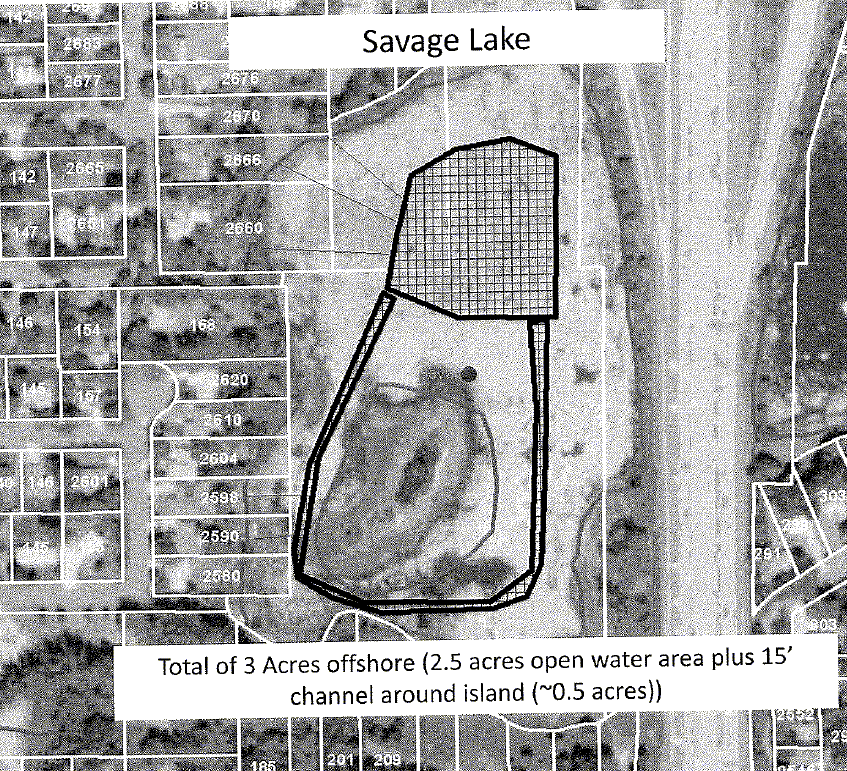
Savage Lake residents were permitted to control 3 acres of water lilies and to clear channels from their shoreline to the open water area. Apparently, some channels were denied because there was no evidence of recreational use along the shoreline. Our APM specialist who did the inspection was very liberal in determining evidence of recreational use; anyone with a dock, boat, canoe, kayak, or paddle boat was authorized a permit. One individual, who did not have a boat on the water, sent a picture of their boat with current registration and the permit was amended within a couple of days to allow a channel for that person. If there are other people in a similar situation, we would certainly be willing to amend the permit for them as well. These folks should contact Sean Sisler (651-259-5807; sean.sisler@state.mn.us) if they wish to amend the permit.
You also expressed concern with the amount of time it took for Savage Lake residents to receive their APM permit, indicating that there was more than a 30-day lag time. In checking with APM staff, however, I learned that DNR received the permit application on July 21 and mailed out the permit two weeks later on August 5. This seems like a reasonable turn-around time, especially since this was a new permit requiring a field inspection prior to issuance.
I hope that this has helped to address your concerns. Please let me know if you need additional information.
Sincerely,
Steve Hirsch, Director
Division of Ecological Resources
(651) 259-5106
Aug 22, 2010
In City Council Notes
August 11, 2010: The City Administrator reported that a DNR Permit has been obtained for spraying of the lily pads on West Savage Lake. That permit includes spraying to obtain an open area around the island and channels connecting properties to the open area. However, the permit excludes five properties from having a channel. The Administrator indicated that he will discuss this with the DNR and likely appeal the restriction.
Blesener asked if Mr. Day had been contacted with regard to coordination of the spraying effort. The Administrator indicated that he has sent an email to Mr. Day and asked to set up a meeting to coordinate the spraying approach.
Aug 21, 2010
Done
I wish I had more energy to talk about the herbicide application on the lake, but John and I hit the lake at 6:30 this morning and finished at just before 4PM. 6.6 miles of slogging through lilies and milfoil. Because of GPS issues, we stayed well inside of the DNR's application map. 9 hours of plowing that swamp was more than enough work for the two of us. My everything is sore.
This was the first time I've been on the lake since early June, when the weeds took over. The lake is in terrible shape, with very little animal life left on or in the water. We saw about a half-dozen painted turtles, the same number of ducks, no snappers, no geese, no herons or egrets, no minnows or small fish, just bugs and weeds. In 14 years of living on the lake and regularly canoeing it, this was very close to the least life I have seen on it. Usually this time of the year we have birds, adolescent geese and ducks, lots of turtles sunning themselves, and minnows. Not this year.
With the lake in this kind of shape, I have to wonder what the Watershed District folks are doing when they take their monthly prowl of the lake? There is no way anyone even mildly knowledgeable would consider this healthy water: lake or watershed. The good news is that the levels are up, but the lake is, for the most part, dead outside of invasive plant species.
There are some significant patches of little-to-no lily growth that I would like to have explained. The lily outbreak began near the island beaches. In 2000, the only lilies to be spotted on the lake were on the east and south edges of the island. By 2003, that area was beginning to be overgrown as the water level was forced grossly below normal levels by the new drain installation on the east lake. After several years of low rainfall and improper lake drainage, the lilies had spread all over the lake. The sediment drainage from the freeway revision raised the lake floor dramatically at the northeast end of our lake and the normal deep end of the lake began to fill in. All of this contributed to increased plant contamination; which contributes to sediment build-up and even more favorable conditions for plants. This summer, however, the lilies have receded from the island's shores and there are several relatively low water points with very little lily infestation.
Oddly, the east side of the lake looks untouched by all this contamination. Obviously, something significantly different is happening to that side of the lake.
The caution signs should stay out over the weekend, but they can be removed Sunday evening. We have some floats on the lake marking our outer boundaries and I'll remove them Sunday. The Dow Rodeo data says we should begin to see the effects of the spraying after 48 hours. Hopefully, this time next week we will be able to use the lake again.
This was the first time I've been on the lake since early June, when the weeds took over. The lake is in terrible shape, with very little animal life left on or in the water. We saw about a half-dozen painted turtles, the same number of ducks, no snappers, no geese, no herons or egrets, no minnows or small fish, just bugs and weeds. In 14 years of living on the lake and regularly canoeing it, this was very close to the least life I have seen on it. Usually this time of the year we have birds, adolescent geese and ducks, lots of turtles sunning themselves, and minnows. Not this year.
With the lake in this kind of shape, I have to wonder what the Watershed District folks are doing when they take their monthly prowl of the lake? There is no way anyone even mildly knowledgeable would consider this healthy water: lake or watershed. The good news is that the levels are up, but the lake is, for the most part, dead outside of invasive plant species.
There are some significant patches of little-to-no lily growth that I would like to have explained. The lily outbreak began near the island beaches. In 2000, the only lilies to be spotted on the lake were on the east and south edges of the island. By 2003, that area was beginning to be overgrown as the water level was forced grossly below normal levels by the new drain installation on the east lake. After several years of low rainfall and improper lake drainage, the lilies had spread all over the lake. The sediment drainage from the freeway revision raised the lake floor dramatically at the northeast end of our lake and the normal deep end of the lake began to fill in. All of this contributed to increased plant contamination; which contributes to sediment build-up and even more favorable conditions for plants. This summer, however, the lilies have receded from the island's shores and there are several relatively low water points with very little lily infestation.
Oddly, the east side of the lake looks untouched by all this contamination. Obviously, something significantly different is happening to that side of the lake.
The caution signs should stay out over the weekend, but they can be removed Sunday evening. We have some floats on the lake marking our outer boundaries and I'll remove them Sunday. The Dow Rodeo data says we should begin to see the effects of the spraying after 48 hours. Hopefully, this time next week we will be able to use the lake again.
Aug 19, 2010
Using the Lake Regardless of a Few Plants

On the lighter side, a pair of lake shore residents appear to using the lake without impediment. It makes me feel like a total wimp to see these folks out enjoying a summer afternoon while I'm spending my time whining about a few plants.
Will wrote, "While I was disappointed not to see you out there, I did manage to snap a photograph of two Savage Lake residents enjoying the lake. (see attached.) I wanted to ask them if their permit application has been approved, but they were too busy to stop and chat."
Labels:
aquatic plants,
recreation,
water lillies,
watershed district
Aug 17, 2010
On hold because . . .
Today would have been the perfect day to spray the lake. However, John and I are stuck because neither of us have the right kind of GPS unit to run the DNR's software. Because of the precision required from the DNR, we need to be sure we are applying Rodeo exactly where they have allowed us to spray. To do that, we need to be able to map our location accurately, which this software does for us. However, my GPS unit won't accept the software at all and John's is a Cobra unit which is also incompatible. If any of you have a GPS unit that is compatible with this program and would be willing to loan it to us for the herbicide application, it would be greatly appreciated.
Our deadline for spraying the lilies is the end of this month, the permit expires on September 1.
Aug 11, 2010
The Permit is Here
Joel received the approved "Permit to Destroy Aquatic Vegetation" from the DNR on Tuesday, the 10th. Mostly, our application was approved as submitted.However, several lake shore homeowners will not be getting their channels to the cleared area because the DNR deemed those properties has having "NO REC USE." I don't know what that means, but I'll get more information from Joel this week and I'll let you know what I find out.
I think the end result is that those 15' channels to the open area will only be cleared for 7 of the 12 property owners who applied for relief from the lily infestation.
I have a copy of the official DNR form, in PDF format, and if you would like a copy please email me through this blog or directly to my home email: twday60@comcast.net. A copy of the list of lake shore owners' and the result of their application is at right.
Aug 7, 2010
So Tired of Waiting
Approximately one month after submitting the application to the DNR and we're still waiting for their response. Since that slow-moving, dysfunctional bureaucracy has no actual function, except to burn taxpayers' money, we have no leverage on them. The DNR sat by and watched our lake turn into a mosquito breeding swamp and did everything it could to restrict any actions that might have saved Savage Lake.Now that the city and lakeshore residents are trying to take that responsibility into their own hands, the DNR is doing what it does best: nothing. With an annual budget of "$835.1 million" you'd think they might be interesting in accomplishing something with that giant outlay. You'd be wrong. In one of his rare moves that I agree with, Pawlenty "unallotted $2.950 million for the biennium"2010-2011 from the DNR's budget. I'd recommend unalotting a whole lot more until the bureaucrats in the DNR realize that they have to earn taxpayers' money. Currently, they obviously feel they deserve that outlay simply because past DNR employees actually worked for a living.
Yeah, I'm disgusted. I was disgusted by the babble I've heard from DNR representatives at every Savage Lake meeting since 2004 and I'm even more disgusted with that collection of inert bureaucrats today. If any state representative or administrator wants my vote, all they have to do is promise to de-fund the DNR and I'm on their side.
Jul 7, 2010
Lily Eradication
The plan to clear a good bit of our lake with herbicide is in place and the city is ready to pay for permits and the necessary materials. Once the permits are approved, John Bibeau and I are going to apply the herbicide by canoe. The city has sent a letter, with application forms included, to all of the west side lake shore owners, which must be completed and returned to the city by July 12, if you want to have your property's water access joined to the central lake area. The central areas will be cleared regardless of how many lakeshore owners request boating and recreational access.
Filling out the blanks in the form may be slightly tricky, if you don't know the length of your shoreline or the distance from your property to the proposed cleared central area or the 10' channel that will be cleared around the island. I talked to Joel Hansen about the values needed in the form and he said the DNR isn't looking for precise numbers, particularly for the distance from your property to the cleared central areas, but he provided a great resource for getting approximate numbers: the Ramsey County GIS Users Group and the mapping resource available at that site (http://maps.metro-inet.us/RamseyCoGIS/CXviewer.htm#). Give the form your best estimate and get it in on time.Even if you know the information requested in this form, I recommend you bookmark these sites for future reference.
Subscribe to:
Posts (Atom)